
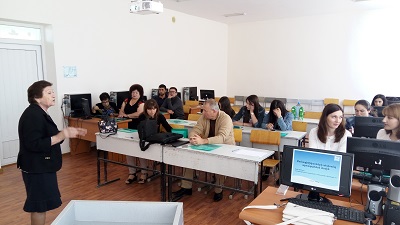

“Armenian Women for Health and Healthy Environment” NGO (AWHHE NGO) jointly with “Environmental Monitoring and Information Center” SNCO of the Ministry of Nature Protection of the Republic of Armenia, with the support of Aarhus Centre Coordinator Lianna Asoyan, has organized a seminar dedicated to raising the population’s awareness of the issues of persistent organic pollutants, particularly of the use of pesticides, their waste generation, nature and influence and the proper management at the Faculty of Natural Sciences of Gavar University on September 19, 2018. The other issue covered during the seminar refers to the impact of the household waste generation in the settlements and the resulting harmful substances (dioxins, furans and other solid substances) emitted into the environment.
The seminar was attended by 26 active representatives- students, lecturers, Aarhus Centre staff and activists.
Expert of AWHHE NGO L. Simonyan presented detailed information on the types of pesticides used in the republic, their labeling, proper selection, transportation, storage and security rules and the use of personal protective means.
She noted that a large number of persistent pesticides were used in the list of persistent organic pollutants in the republic many years ago. Since the 1980s their use has been prohibited in the republic, and more than 500 tons of pesticides has been collected and buried not far from Yerevan. However, the site is located in the landslide zone and it is necessary to displace and defuse in order to provide a final solution to the issue.
Now an interdepartmental commission is formed to deal with a number of international experts on these issues.
Expert Lilik Simonyan mentioned that 50-60% of the pesticides buried there are persistent organochlorine pesticides. She specifically mentioned DDT and HCH (hexachlorocyclohexane), which even cause harmful chemical compounds during decomposition.

Expert Knarik Grigoryan presented the second topic. She noted that burning reduces the amount of garbage by about 60-70%. When destroying garbage by burning, many harmful compounds are emitted into the external environment.
Then Knarik Grigoryan talked about the health problems of the residents living in the areas near waste dumps and rubbish.
According to scientific research data from different countries, the risk of having babies with congenital defects increases among women living not far from toxic waste dumps.
There are registered and unregistered waste dumps in our country, where garbage is dispersed without distinction and mixed, which increases the risk of the above-mentioned diseases.
The environmental issues were discussed and proper answers were given to the raised questions. All participants were distributed information materials.