
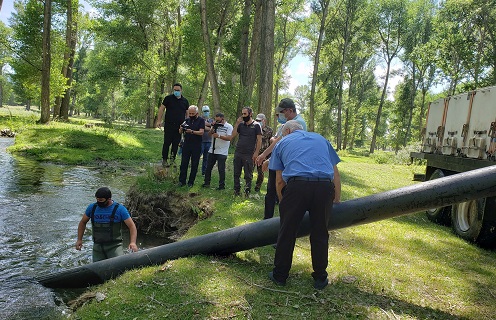
 On July 17,about 300.000 juvenile fish of “Gegharkuni” sort of Sevan trout, weighing 1.5- 3 grams on average, were released into Karchaghbyur and Masrik rivers flowing into Lake Sevan by the fish farming complex of“SevaniIshkhan” CJSC in Karchaghbyur. The juvenile fish were released in the presence and participation of representatives of the relevant commission of the RA Ministry of Environment, RA Deputy Minister of Environment VardanMelikyan, Gegharkunik Regional Administration, the Institute of Hydroecology and Ichthyology of the RA NAS, Center for Territorial Development and Research and BLEJAN NGOs.Before the event, a discussion was heldin the complex under the leadership of RA Deputy Minister of Environment Vardan Melikyan on key issues of introducing a new procedure for industrial fishing in Lake Sevan.
“By introducing a new procedure, we must minimize the cases of illegal fishing in Lake Sevan, bringindustrial fishing in Lake Sevan in line with legal standards. I am not saying that the new procedure introduced by the Armenian government is ideal, new problems won’t arise, but I am sure that during that time, it will be successfully tested and improved with the help of our joint efforts.Sevan National Park must be equipped with technical means, the inspection sphere must be strengthened, certain changes must be made in the tax administration.We must reach the point where on the one hand we can solve the country’s food problem, on the other hand we can increase the fish stock in Lake Sevan. One of the steps undertaken for this purpose is enshrined in the activity program of the Fund of Restoration of Stocks of Sevan Trout and Development of Aquaculture”, said the Deputy Minister.
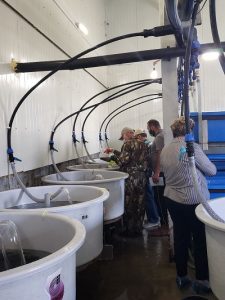
LiannaAsoyan, a representative of BLEJAN NGO, who participated in the meeting, asked questions about various risks that would arise during those processes, an example of which is that we do not and cannot have a stock of finally estimated fish stocks, as there are illegal fishing every day, and no one can say for sure how many broodstocks we have, how many juvenile fish and how many newborn fish there are, etc.In other words, on cannot mention any precise fish stock, as long as the illegal fishing is not temporarily stopped and there is no control.
A discussion was held, and it was decided to continue the discussion for another day, for a longer period.
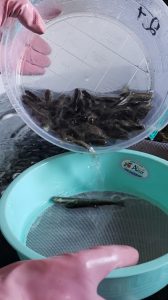
The members of the commission participated in the whole process of counting and weighing the juvenile fish. 126,000 juvenile fish weighing up to 1.67 grams were released in the middle reaches of the Karchaghbyur River, and about 175,000 juvenile fish weighing up to 3 grams were released in the middle reaches of the Masrik River.TigranVardanyan, acting director of the fish farming complex of “SevaniIshkhan” CJSC in Karchaghbyur, mentioned that the Fund’s liabilities included to release of 62,000 juvenile fish of “Gegharkuni” sort weighing 3 grams into Lake Sevan.
The remaining 260,000 juvenile fish, weighing up to 3 grams, are released into the lake with a donation from the fund.After releasing the juveniles, the officers of Sevan National Park were on duty in the area until the juveniles got used to the environment and swam to the lake.
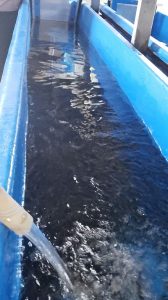 In fact, the factory (fish farming complex) is unique in its kind in the region, where attempts are made to have exclusively endemic “Gegharkuni” and “Summer” species of the trout (ishkhan), but concerns of the NGO representatives about the impact of the farming nets on Lake Sevan remain unchanged. It is true that the implementers of the program try to claim the opposite and to represent arguments that the lake is being polluted more every day in the form of sewage from the rivers flowing into the lake, than from the farming nets monthly, because their food is completely natural- Dutch-made, but concerns remain as long as there is no scientific research and information that they do not have harmful impact on the lake.